
The Comitas Gallery
Bolivia1 9 6 4 — 1 9 6 9
Scroll
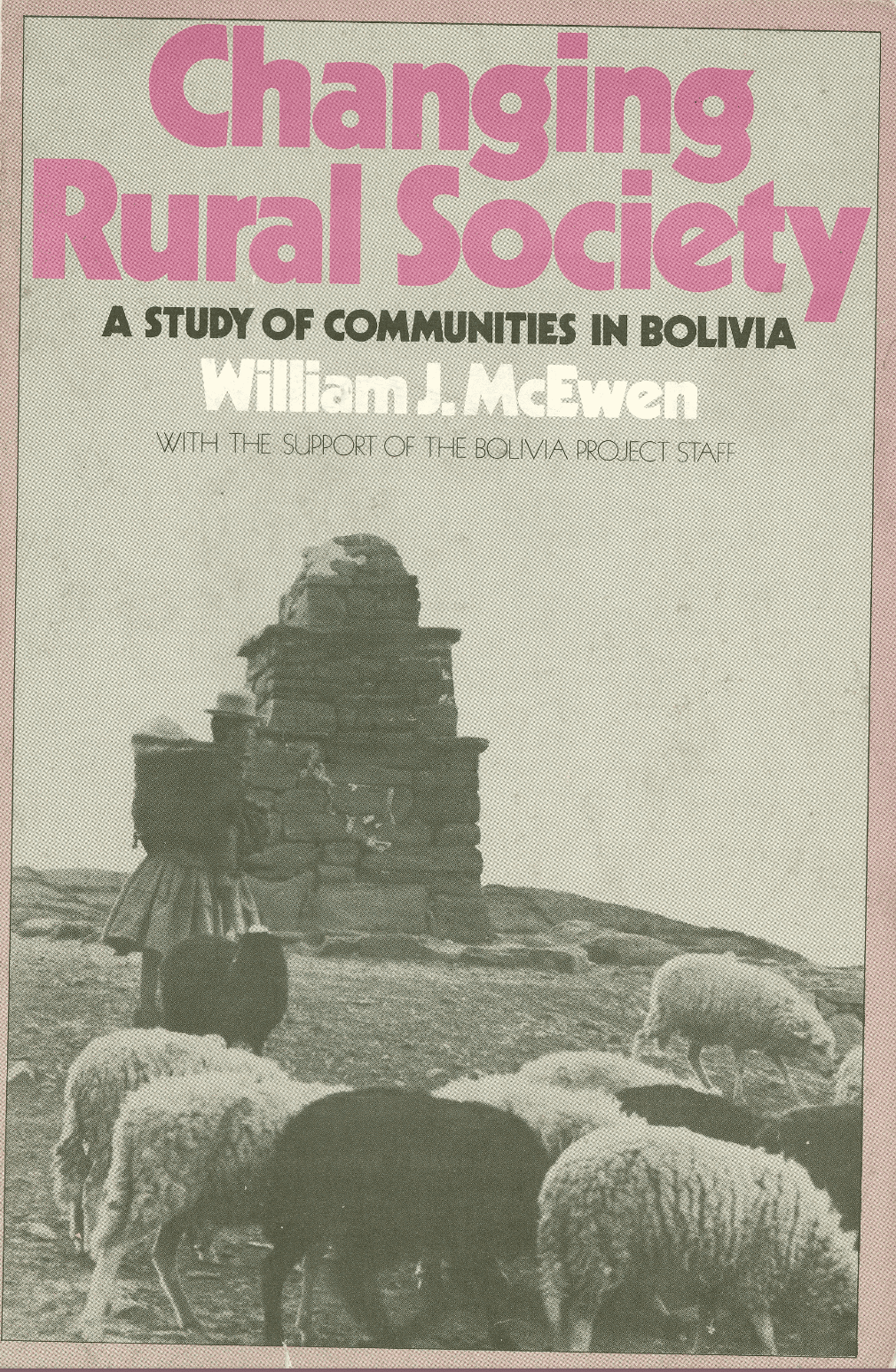 Changing Rural Society · Oxford University Press, 1971
In 1964, at the request of the U.S. Peace Corps, the Research Institute for the Study of Man (RISM) initiated an intensive three-year medical-anthropological research program in Bolivia, in cooperation with the Bolivian Ministry of Public Health. The project was led by RISM founder and director Dr. Vera Rubin, alongside associate director Lambros Comitas and research director William J. McEwen.
Over eighty medical and social scientists, field workers, and staff were distributed across six ecologically distinct communities—Villa Abecia, Coroico, Reyes, Sorata, and the Aymara pueblos of Compi and San Miguel. Each community represented a different organizational type, from minimally stratified to politically revolutionized.
Clinical studies were conducted on a sample of 3,000 subjects, while the ethnographic team delineated the social features of each community through comparative studies of social relations and social processes.
— Map from Omran, McEwen & Zaki, Epidemiological Studies in Bolivia: Final Report for the Peace Corps (RISM, 1967)
The region studied had been profoundly reshaped by the 1952 Revolution, when the Nationalist Revolutionary Movement (MNR) seized power. The new government granted universal suffrage, nationalized the tin mines, and launched sweeping land reform—redistributing the country's resources among politically mobilized campesinos from the rural Aymara and Quechua populations.
Among its most ambitious efforts was the dramatic expansion of rural education—a fivefold increase in schools by 1965. It was this transformation that RISM sought to document and understand.
— Comitas, "Education and Social Stratification in Contemporary Bolivia" (1967)
The RISM project's ethnographic findings were published as Changing Rural Society: A Study of Communities in Bolivia by William J. McEwen, with the support of the Bolivia Project staff. Released by Oxford University Press in 1971, the book examined the human consequences of the revolution's economic, political, and educational reforms across the six communities studied.
The cover photograph was taken by Lambros Comitas.
— McEwen, Changing Rural Society (Oxford University Press, 1971)
Partly as a result of the RISM Bolivia Project, the U.S. Office of Education sponsored a comparative study of rural education in Argentina, Bolivia, and Jamaica. The principal investigator was Lambros Comitas, then Professor of Anthropology and Education at Teachers College, Columbia University.
Armed with a Sony Videocorder and CV reel-to-reel videotape, he returned to Bolivia in March 1969.
— RISM Archival Finding Aid, Series X: Audiovisual Materials · New York University Archives
Comitas shot hours of rare footage in the schools of Compi, Sorata, and Coroico—capturing grade levels, gender composition, and teaching methods during a period of intense national transition. These recordings survive as some of the earliest video documentation of rural education in Bolivia.
Also among the archival materials is The Living, a 16mm film reel whose content remains undigitized and unavailable for this exhibition.
— RISM Archive, Box 314: Audiovisual Materials · New York University Archives
Located on the shores of Lake Titicaca in the Department of La Paz, the Aymara pueblo of Compi provided a window into rural education in the high Altiplano. It was one of two Indigenous communities in the study, representing a minimally stratified social type—a contrast to the more complex towns like Sorata.
Compi was an Aymara pueblo — and in communities like this one, Comitas found that as many as 84% of the population spoke no Spanish at all. Yet from the first grade onward, government policy demanded all instruction be conducted exclusively in Spanish — a policy of castellanización that left children unable to understand a word their teacher was saying.
What followed was an extreme form of rote learning: the teacher spoke, the children copied words into their course books, and memorization replaced comprehension entirely. The footage below captures exactly this dynamic — six recordings spanning pre-school through sixth grade in a single Altiplano schoolhouse.
— Comitas, "Education and Social Stratification in Contemporary Bolivia" (1967)
A mountain village close to Ilampu and Ancohuma, two of the highest peaks in the Andes. Unlike Compi, Sorata was a complex, stratified town. The ethnographic team lived here to conduct comparative studies of social relations among its multiple social segments—indigenous, cholo, and elite.
In analyzing communities like Sorata, Comitas observed that for the rural Indigenous population, education represented one of the only avenues for social mobility. Many viewed schooling as a catalyst to migrate to towns and transition into the cholo middle class—the town-dwelling social segment traditionally disliked by elites and feared by Indians.
Much of the Sorata videography focuses on "Student Demonstrations"—sessions where students actively recited and performed the curriculum, reflecting the intense pressure to assimilate into national culture through the Spanish language.
One reel from the Sorata inventory — a 3rd-grade classroom instruction — is catalogued but unavailable for this exhibition.
— Comitas (1967)
Located in the Yungas region, where the Andes drop sharply toward the Amazon basin. Coroico is culturally distinct, known for its rich Afro-Bolivian heritage, transplanted Aymara populations, and deep agricultural ties to coffee and coca production.
Comitas's data from this area revealed a stark generational divide: adults over 22 had received virtually no formal schooling — an average of less than one year. The younger generation, benefiting from the MNR's school expansion, fared only slightly better.
For most children here, formal education lasted roughly two years before the demands of the fields won out. The seven recordings below capture classrooms at that exact threshold — second grade through mixed upper grades — documenting the brief window in which this first generation of students encountered a national curriculum taught in a language most of their parents had never spoken.
— Comitas (1967); data from Newman (1966)